
Key Takeaways
- An upright vacuum puts the motor, bin, and cleaning head in one body.
- A canister vacuum separates the motor unit from a hose and wand.
- Uprights usually suit carpeted, open rooms and simple storage.
- Canisters usually suit mixed floors, stairs, and tight spaces.
- Neither design wins overall, so your floors and layout should decide.
Shoppers often ask which vacuum design is better. However, the honest answer depends on your home. Canister and upright vacuum cleaners are built in very different ways. Those differences shape how they clean, feel, and store. As industry specialists at bestvacuumcleaner.us frequently warn, buying the wrong format for your flooring type leads to premature motor wear and poor airflow. This guide explains the design differences clearly so you can choose the right style with confidence.
How Each Design Is Built
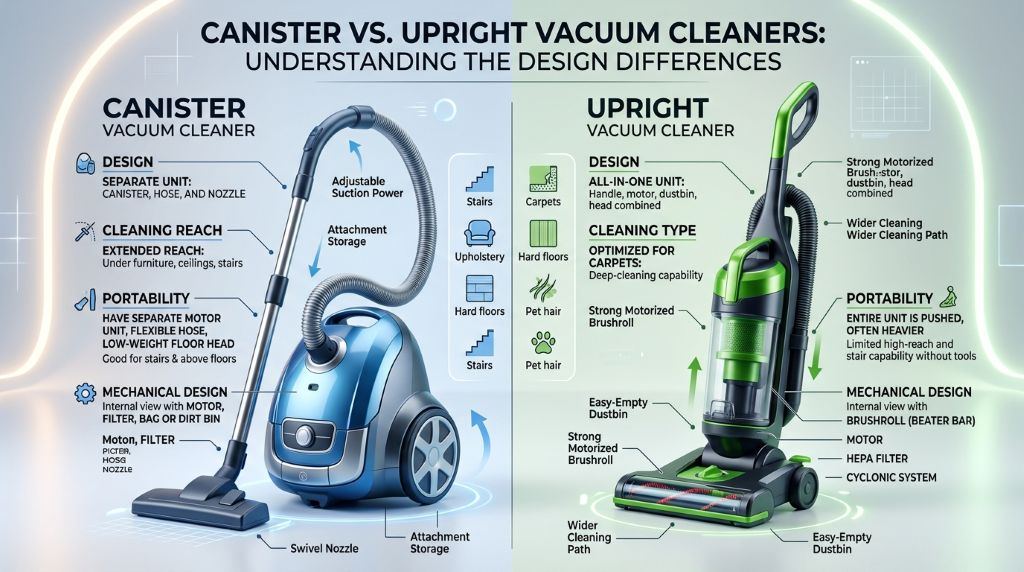
An upright vacuum combines everything in one tall unit. The cleaning head, motor, and dust container all sit in a single body. You push it across the floor in front of you. Therefore, you move the whole machine as you clean.
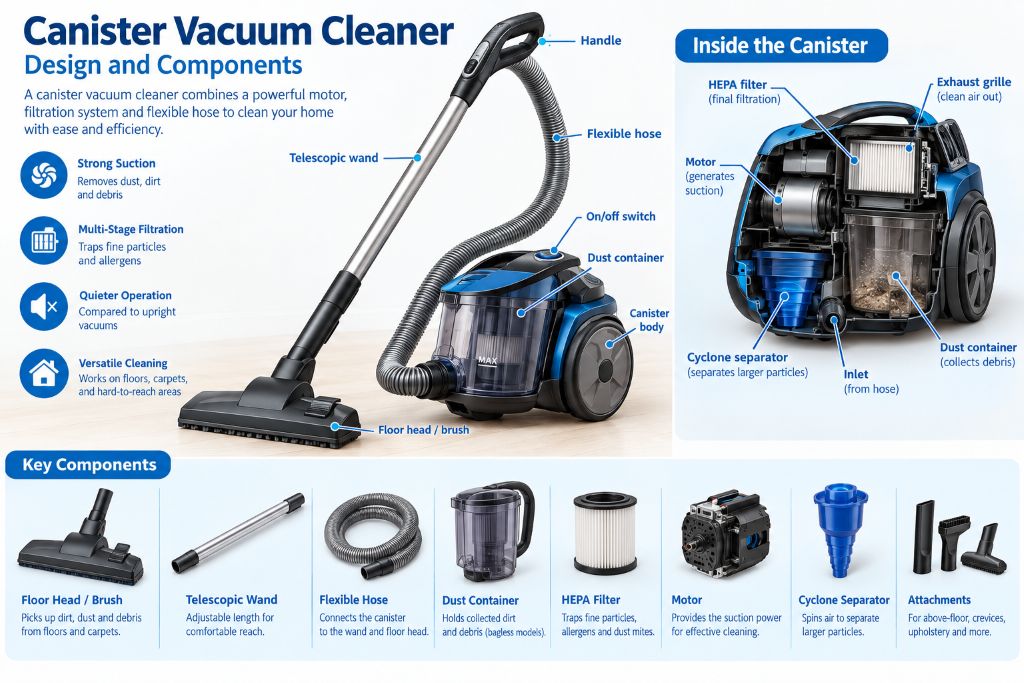
A canister vacuum splits the parts into two sections. The motor and dust container sit in a separate body on wheels. A flexible hose connects that body to a wand and cleaning head. As a result, you guide only the lightweight wand while the canister follows behind you.
This split design changes how the machine handles weight. According to Dreame, separating the power source from the cleaning tool allows a larger motor while keeping the wand light. Its example figures show a full upright weighing about 16.5 pounds, while a canister wand weighs about 2.6 pounds. These numbers vary by model, but they show the core idea.
The upright’s single body has its own benefits. Weight sits directly over the brush roll. That helps the brush press into carpet and loosen embedded dirt. Additionally, one-piece construction means fewer parts to assemble or lose.
Neither design is automatically stronger. Rocky Mountain Sewing notes that the model, cleaning head, airflow, and filtration matter more than the basic shape. Keep this in mind as you compare specific machines. A well-built upright can beat a poor canister, and the reverse is also true.
Cleaning Performance on Different Floors
Floor type is the biggest factor in this decision. Each design has surfaces where it shines.
Uprights excel on carpet. Their motorized brush roll sits close to the motor and carries the machine’s weight. Dreame explains that this design uses both physical force and suction to lift stubborn dirt. Consequently, uprights often handle thick or plush carpet very well.
Canisters shine on hard floors. They typically use a soft-bristle floor head that picks up fine dust without scratching. Furthermore, they scatter less debris than a spinning brush roll can. Consumer Reports rates canister vacuums as best for hardwood floors for these reasons.
Canisters can also clean carpet. Many models include a motorized power head for this task. However, uprights are built around this job. Therefore, a home with mostly thick carpet often suits an upright better.
Here is a quick guide to floor matches.
- Thick or wall-to-wall carpet: upright usually leads
- Hardwood, tile, and laminate: canister usually leads
- Mixed floors throughout the home: canister often works better
- Area rugs on hard floors: canister with adjustable head works well
- Large open rooms: upright covers ground quickly
Some canisters include two heads. One is a height-adjustable head for rugs. The other is a soft-bristle head for hardwood. Prudent Reviews points out this flexibility as a strong advantage for mixed-floor homes.
Maneuverability, Stairs, and Reach
Design differences show up most when you clean around obstacles. Here the canister has a clear edge.
The flexible hose lets you twist and turn the cleaning head freely. You can slide the wand under a bed or sofa with little effort. Sylvane notes that canister models are easier to reach into tight areas such as stairs and beneath furniture. Additionally, the heavy body stays on the floor while you work.
Stairs make the difference obvious. Carrying a full upright up a flight of steps is tiring. In contrast, you can set a canister on a step and reach several treads with the hose. Consumer Reports lists stairs as a weakness of uprights and a strength of canisters.
Canisters also come with more attachments. Dreame lists five to six standard tools for its example canister, compared with two to three for the upright. These tools clean curtains, upholstery, vents, and shelves. Therefore, a canister works as a whole-house cleaning system.
Uprights have their own maneuvering strengths. You steer them with one handle. Many models also include a detachable hose or wand for quick jobs. Even so, they can feel bulky around furniture legs and tight corners.
One drawback of canisters deserves mention. The body can bump into walls and furniture as it trails behind you. Some users also find the hose awkward at first. However, practice usually solves this problem quickly.
Storage, Noise, and Capacity
Daily habits matter as much as cleaning power. Consider where you will keep the machine and how it sounds.
Storage favors the upright in many homes. It stands upright in a closet corner and takes little floor space. Dreame’s example shows an upright using about 1.1 square feet, while the canister needs about 2.2 square feet. Consumer Reports also lists easy storage as a plus for uprights and bulky size as a minus for canisters.
Noise often favors the canister. The motor sits inside the canister body, which helps dampen sound. Sylvane points to quieter operation as a canister benefit. In addition, Consumer Reports notes that uprights tend to be noisier than other types. This can matter if you vacuum while children nap or pets rest.
Dust capacity differs by design as well. Red Vacuums notes that many uprights have larger dust bins, so you empty them less often. However, many canisters with bags also hold a lot of debris. Check the stated capacity for any model you consider.
Price and weight vary widely. Consumer Reports lists upright weights from 8 to 23 pounds and canister weights from 15 to 26 pounds. Note that a canister’s listed weight includes the body you pull, not the wand you hold. Therefore, compare the weight you actually carry.
Use this checklist before you buy.
- Measure your closet or storage space for the machine.
- Count how many stairs you must clean regularly.
- List your floor types and note the largest area.
- Decide whether noise is a serious concern.
- Compare attachments and dust capacity for each model.
Which Design Fits Your Home?
You now know how the designs differ. Next, match them to your situation.
Choose an upright if your home has mostly carpet. It also suits larger open rooms and small storage spaces. Additionally, uprights usually cost less at the entry level. Prudent Reviews sums up the trade-off simply. Uprights are simpler and easier to store, but they are heavier, noisier, and less flexible on stairs and in tight areas.
Choose a canister if you have mixed flooring. It also works better for homes with many stairs, low furniture, or delicate hard floors. The added attachments help with above-floor cleaning as well. However, expect a bulkier storage footprint and a higher price in many cases.
Some homes do not fit either label neatly. You may have hardwood downstairs and carpet upstairs. In that case, a canister with a power head covers both. Alternatively, some households own a lightweight canister plus a small stick vacuum for quick jobs.
Whichever you pick, test it in person when possible. Push it, lift it, and try the attachments. A machine that feels comfortable gets used more often. As a result, your floors stay cleaner.
Conclusion
Canister and upright vacuums differ mainly in how they are built. Uprights combine everything into one body and work well on carpet, while canisters separate the motor from a light wand and excel on stairs, hard floors, and tight spaces. If you frequently clean hard surfaces, it is also important to know how to vacuum tile floors properly without causing scratches, as the right attachment and technique can help protect the flooring. Each vacuum type has trade-offs in weight, noise, storage, and price.
Let your floors, stairs, and storage space guide the decision. Ignore the idea that one design is always better. Make a quick list of your home’s needs today. Then compare models that match it, and choose the vacuum that makes cleaning easier.
Frequently Asked Questions
Is a canister or upright vacuum better for carpet?
Uprights usually clean thick carpet better. Their weight and brush roll sit directly over the floor.
Are canister vacuums quieter than uprights?
Often yes. The motor sits inside the canister body, which helps reduce noise.
Which vacuum type is better for stairs?
Canister vacuums are easier on stairs. You carry a light wand while the body stays put.
Do canister vacuums cost more than uprights?
Often they do, though prices overlap widely. Compare specific models instead of relying on type alone.
Can one vacuum handle both carpet and hard floors?
Yes. Many canisters include a power head and a soft floor head for mixed surfaces.