

It happens on a Saturday morning in July: you slide under the deck to clear a clogged chute or swap a blade, and the mower shifts just enough to make your pulse spike. In Texas, where mowing season stretches from March through November in many areas, that scenario plays out on driveways and in garages far more often than it should. The fix is not complicated, but it does require the right equipment and a repeatable routine. Whether you are comparing reliable lawn mower jacks for Texas homeowners or working with what is already in your shop, the goal is the same: get the machine up, keep it stable, and never put your body under a load that could drop. This guide walks through the full process, the common mistakes, and the gear that actually holds up on uneven ground.
Quick Answer
Lift a riding mower by parking on a hard, level surface, setting the parking brake, chocking the wheels that stay on the ground, and raising only the deck or the end you are working on with a jack rated well above the mower’s weight. Use jack stands or a dedicated mower lift to support the load before you reach underneath. Never rely on a hydraulic jack alone to hold the machine, and never work under a mower supported only by the deck or by blocks of wood.
Key Takeaways
- A hydraulic jack raises the mower; jack stands or a purpose-built lift hold it. Those are two separate jobs, and skipping the second one is the most common cause of injury.
- Slipping is the real danger on a riding mower because the frame is narrow, the weight is unevenly distributed, and the wheels roll easily.
- Deck service and blade changes usually require only a partial lift, which is lower risk than raising the entire machine.
- Soft ground, gravel, and sloped driveways dramatically increase the chance of a jack tipping or a stand sinking.
- Chocking the wheels that remain on the ground is not optional, even when the parking brake is engaged.
Why Riding Mowers Are Trickier to Lift Than They Look
A riding mower looks like a small car, but it behaves very differently on a jack. The frame is narrow, the center of gravity sits high and toward the rear, and the machine rolls on four pneumatic tires that can shift a fraction of an inch under load. A floor jack designed for a 3,000-pound sedan has a wide, stable base and lifts a heavy, low frame. A riding mower has none of those advantages.
The weight distribution is the part people underestimate. On a typical lawn tractor, the engine and transmission push most of the mass toward the rear axle, while the deck hangs forward of the front wheels. Lift the front bumper with a jack and the machine pivots on the rear tires more easily than you expect. Lift the rear and the front end can feel light and unstable. Either way, a single point of contact is doing all the work.
Add Texas conditions and the risk climbs. Clay soil holds moisture and softens after rain. Gravel driveways offer almost no grip for a jack caster. Concrete is usually the best option, but even a slight slope in a driveway can send a jack rolling while a mower is in the air. The practical takeaway is simple: the surface you work on matters as much as the jack you use.
What You Actually Need Before You Start
You do not need a full shop setup, but you do need a few specific items, and the list is shorter than most people assume.
- A jack rated well above the mower’s weight. Riding mowers commonly fall in the 400 to 800 pound range depending on size and deck width, so a jack rated at 1,000 pounds or more gives you a real safety margin.
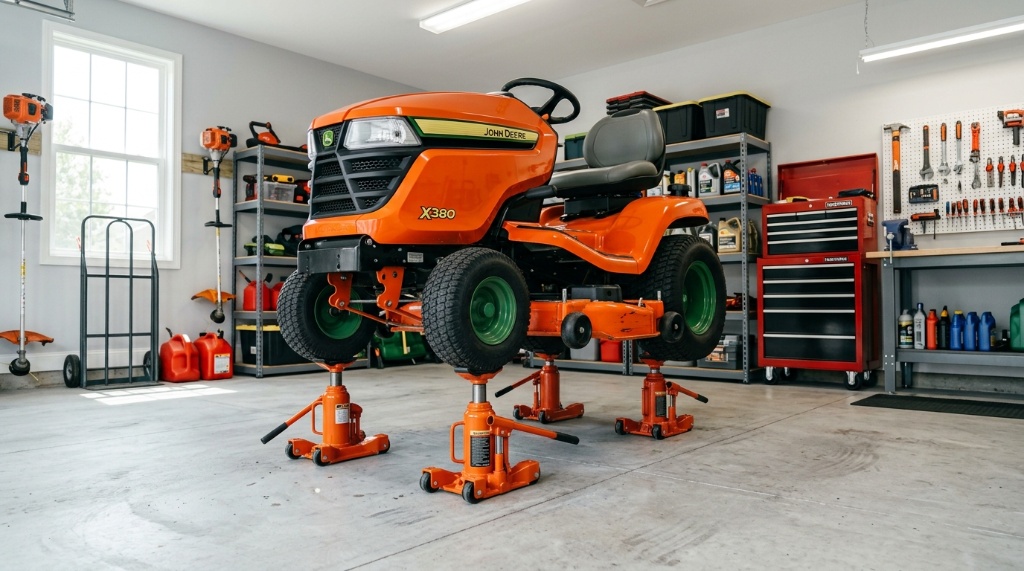
- Jack stands or a dedicated mower lift. Stands must be rated for the load and placed under the frame, not the deck. A purpose-built lift raises the mower evenly and locks in place.
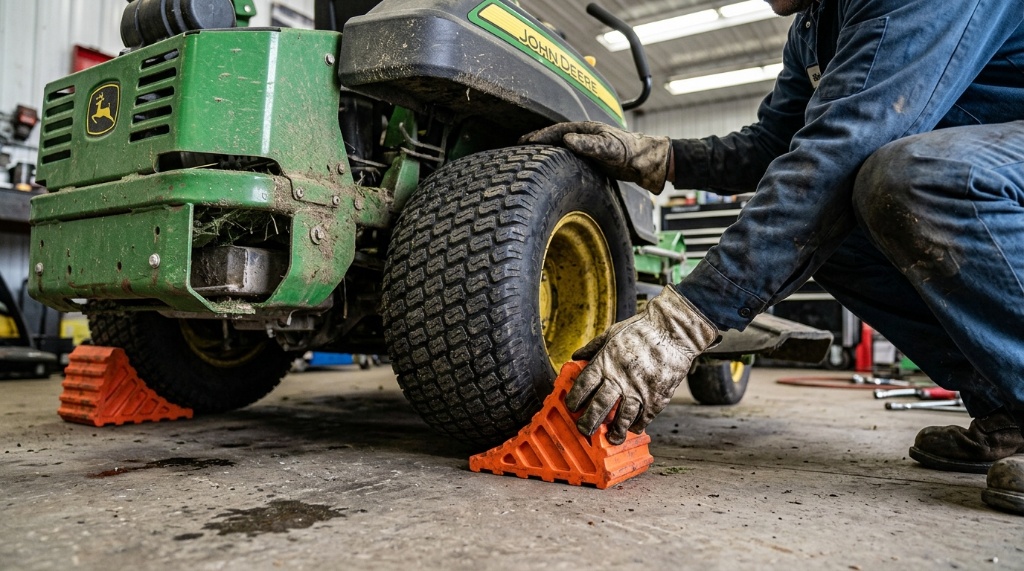
- Wheel chocks. Two solid chocks for the wheels staying on the ground. Rubber chocks grip better than plastic on concrete.
- Wheel blocks or a second set of stands if you plan to remove a wheel.
- Gloves and eye protection. Deck work throws debris, and blade edges are unforgiving.
If you are lifting only the deck for a blade change or a cleaning, the requirements are lighter. Many riders can be raised at the front with a single jack and supported with one or two stands under the front frame rails. That is a far safer operation than lifting the whole machine, and it covers most routine maintenance, For more gardening equipment advice, check out our guide on essential lawn and garden hoe tools every gardener should know.
Step-by-Step: Lifting a Riding Mower Safely
- Move to a hard, level surface. Concrete is ideal. Avoid grass, gravel, and any noticeable slope. If your only option is a sloped driveway, reposition the mower so the slope runs front-to-back rather than side-to-side, and chock accordingly.
- Empty the deck of debris and let the engine cool. A hot engine and a fuel tank near a jack are a bad combination. Disconnect the spark plug boot before any work near the blades.
- Set the parking brake and chock the wheels. Chock the wheels that will stay on the ground. On most maintenance tasks, that means the rear wheels. Do not trust the brake alone.
- Identify the correct lift point. Use the frame or the manufacturer’s designated lift point. Never jack under the deck, the transmission housing, or a plastic panel.
- Raise slowly and watch the contact point. If the jack starts to slide or the mower tilts unexpectedly, lower it and reposition. Do not force a lift that feels wrong.
- Place your stands or engage the lift lock before letting go. This is the step that separates a safe lift from a dangerous one. The jack raises; the stand holds.
- Lower the jack slightly so the load rests on the stands. You want the stands carrying the weight, not the jack. Give the mower a gentle push to confirm it does not rock.
- Do the work, then reverse the process. Raise slightly, remove the stands, and lower the mower slowly and under control.
Jack Stands vs. a Dedicated Mower Lift: Which Makes Sense for You
This is the decision most homeowners actually face, and the answer depends on how often you work on the machine and how much space you have.
| Factor | Jack + Stands | Dedicated Mower Lift |
|---|---|---|
| Setup time | Fast, especially for deck-only work | Slightly longer the first time, then quick |
| Stability | Good if stands are placed correctly | Generally better, since the mower is supported across a wider area |
| Storage | Compact, stores on a shelf | Takes up floor space |
| Best for | Occasional blade changes, deck cleaning, tire work | Frequent maintenance, full underside access, older or heavier mowers |
| Cost | Lower upfront | Higher upfront, but often worth it for regular use |
If you sharpen blades once a season and clean the deck a few times, a quality jack and a pair of stands will handle nearly everything. If you maintain multiple mowers, run a small lawn service, or own a heavy zero-turn, a lift earns its place quickly because it removes the guesswork about where to place stands.
Deck-Only Lifting: The Lower-Risk Option Most People Should Start With
A surprising amount of riding mower maintenance does not require lifting the whole machine. Blade sharpening, deck cleaning, belt inspection, and spindle checks can usually be done by raising just the front of the mower high enough to slide under safely.
The advantage is that the rear wheels stay planted, the machine cannot pivot as far, and you need less clearance. The trade-off is that you are still working underneath a raised load, so the same rules apply: chock the rear wheels, use stands, and never trust the jack alone. The lower you can keep the machine while still getting access, the better.
Common Mistakes That Cause Accidents
- Working under a mower held only by a hydraulic jack. Hydraulic seals can fail without warning. The jack is a lifting tool, not a support.
- Jacking on grass or gravel. A jack caster that sinks or rolls turns a stable lift into a falling one.
- Using the deck as a lift point. The deck is not structural and can bend or shift under load.
- Skipping wheel chocks. Parking brakes fail, and a mower on a slight incline can roll even with the brake set.
- Placing stands under a plastic or sheet-metal panel. Stands belong under the frame or a reinforced point.
- Rushing the lower. Most injuries happen during the descent, not the lift, because people stop paying attention once the work is done.
- Lifting a machine with a full fuel tank on a slope. Fuel can spill, and the added weight shifts the balance point.
How Texas Conditions Change the Equation
Texas homeowners deal with a few factors that make safe lifting more important than in milder climates. The mowing season is long, which means more frequent maintenance and more opportunities for a rushed lift. Summer heat makes people want to finish quickly, and heat also softens asphalt, which can cause a jack or stand to sink on a driveway that feels solid in the morning.
Soil type matters too. In areas with expansive clay, the ground moves with moisture, so a spot that was level last month may not be level now. A quick check with a level or even a visual scan before you set up takes seconds and prevents the most common failure mode.
Storage is the other consideration. If your mower lives in a shed or under a cover, you may not have a concrete pad to work on. In that case, the safest approach is to move the mower to a paved area before lifting rather than improvising on dirt.
When to Skip the DIY Lift
Some jobs are not worth doing at home. If you need to remove a transmission, split the frame, or access a component that requires the mower to be raised high and held for an extended period, a professional shop with a proper lift is the better call. The same applies if you are unsure about a lift point or the mower feels unstable no matter how you position the jack.
There is no prize for saving a service fee on a job that puts you under a 600-pound machine in a compromised position. Knowing when to stop is part of doing this safely.
Frequently Asked Questions
Can I use a car jack to lift a riding lawn mower?
You can use a floor jack if it is rated well above the mower’s weight and you support the machine with stands afterward. A standard scissor jack that comes with a car is a poor choice because it has a narrow base and tips easily on a narrow mower frame.
Do I need jack stands if I am only changing a blade?
Yes. Any time your hands or body go under the deck, the mower needs to be mechanically supported. A jack alone can fail, and blade work puts you directly in the path of a falling machine.
How high do I need to lift a riding mower for maintenance?
Just high enough to access the component safely, usually a few inches for blade and deck work. Higher lifts increase instability, so keep the mower as low as the job allows.
Is it safe to lift a mower on a sloped driveway?
It is riskier. If you must work on a slope, position the mower so the slope runs front-to-back, chock both wheels on the low side, and consider moving to a level surface instead. A small slope can still cause a jack to roll.
What weight rating should a mower jack have?
Choose a jack rated at least 1.5 times the weight of your mower. Since many riding mowers weigh between 400 and 800 pounds, a 1,000-pound or higher rating gives a reasonable safety margin.
How often should I inspect my jack and stands?
Check them before each use for leaks, bent components, or worn locking teeth. Replace any stand or jack that shows damage rather than trying to repair it.
Conclusion
Lifting a riding mower safely comes down to three habits: work on hard, level ground; support the machine with stands or a dedicated lift, never the jack alone; and keep the lift as low as the job allows. Do those consistently and most routine maintenance becomes a controlled, repeatable task instead of a gamble. For occasional blade and deck work, a quality jack and a pair of rated stands cover nearly everything. For frequent maintenance or a heavier machine, a dedicated lift is the more stable long-term choice. Either way, the goal is to finish the job and walk away unhurt.


One thought on “How to Lift a Riding Lawn Mower Safely for Maintenance”