

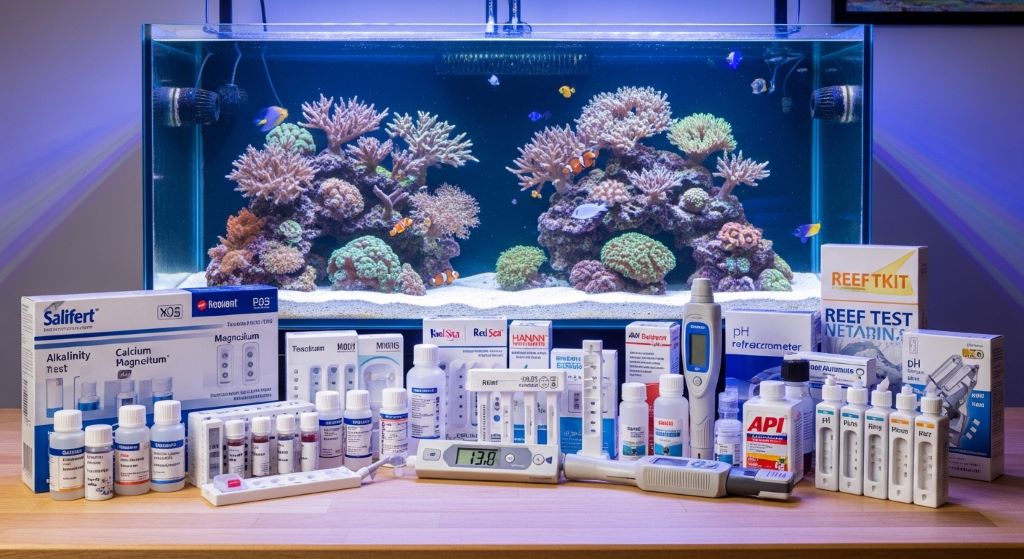
A thriving reef tank is one of the most rewarding things you can create at home. Colorful corals, active fish, and clean water all working together create a living piece of the ocean right in your living room. However, keeping that balance is not something that happens on its own. It takes regular attention and a solid understanding of what is happening in your water.
Water testing is the foundation of every successful reef tank. Without it, you are guessing. And in a reef environment, guessing often leads to coral bleaching, sick fish, or a tank crash. This guide will walk you through everything you need to know to test your water properly, consistently, and confidently at home.
Why Water Testing Is Non-Negotiable for Reef Tanks
Reef tanks are far more sensitive than freshwater setups. Corals, invertebrates, and saltwater fish all have narrow ranges they can tolerate. A small swing in alkalinity or calcium can stress corals within hours. A spike in ammonia can wipe out fish before you even notice something is wrong.
Therefore, testing is not optional. It is the early warning system that tells you what is changing before the damage shows up visually. Many experienced reef keepers say that by the time you see a problem, the water chemistry has already been off for days.
Additionally, consistent testing builds a picture of your tank over time. You begin to understand its rhythms. You learn how quickly your corals consume alkalinity, how your nitrates respond to feeding, and how your tank behaves after a water change. That kind of knowledge is invaluable.
Understanding the Key Parameters to Test
Not all parameters are equally important. However, for a reef tank, there is a core list that every hobbyist should track closely.
Salinity is the starting point. Reef tanks thrive at a specific gravity of 1.025 to 1.026. Even small drifts matter, so checking salinity at least twice a week is wise.
Alkalinity, often called dKH, is critical for coral growth. It fuels the skeletal development of stony corals. Most reef tanks aim for a range of 8 to 12 dKH. Consistency matters more than hitting a perfect number, so avoid large swings.
Calcium works closely with alkalinity. Corals consume both as they grow. A target range of 380 to 450 ppm keeps most reef tanks in good shape. If calcium drops while alkalinity stays stable, your corals are growing fast and consuming resources quickly.
Magnesium supports the balance between calcium and alkalinity. Low magnesium causes both to fall even when you dose them regularly. Aim for 1250 to 1350 ppm.
Nitrate and phosphate are nutrients that feed algae and stress corals at high levels. In a reef tank, lower is generally better. Nitrate below 10 ppm and phosphate below 0.1 ppm are common goals, though some corals actually benefit from trace amounts.
pH rounds out the core list. A healthy reef tank typically ranges from 8.1 to 8.3. However, pH naturally fluctuates throughout the day, so testing at consistent times gives you the most useful data.
Building a Weekly Testing Schedule
Consistency is the key to useful water data. Testing once every few weeks tells you very little. A structured schedule, on the other hand, transforms testing from a chore into a powerful management tool.
A practical aquarium maintenance routine for reef tanks might look something like this:
- Daily: Check salinity with a refractometer or calibrated probe
- Every two to three days: Test alkalinity
- Twice weekly: Test calcium and magnesium
- Weekly: Test nitrate and phosphate
- Weekly: Check pH at the same time each evening
This schedule may look demanding at first. However, most tests take only a few minutes once you are comfortable with the process. Over time, it becomes second nature.
Choosing the Right Testing Equipment
Your results are only as good as your tools. Investing in quality test kits and equipment pays off quickly in accuracy and reliability.
Liquid reagent test kits are a popular choice. Brands like Salifert, Red Sea, and Hanna Instruments are widely trusted in the reef-keeping community. They provide precise readings and are more reliable than basic strip tests.
Digital colorimeters, such as the Hanna Checker series, take human error out of reading color-based tests. They are especially useful for parameters like phosphate, where subtle color differences are hard to read by eye.
For salinity, a quality refractometer calibrated with saltwater-specific fluid gives the most accurate readings. Swing-arm hydrometers are less reliable and should be avoided for reef tanks.
Automated monitors are available for pH, temperature, and salinity. While more expensive, they log data continuously and alert you to sudden changes. For a busy hobbyist, this kind of technology supports strong home tank health without requiring constant manual checks.
How to Test Accurately Every Time
Accurate testing requires more than just following the instructions on the box. There are a few habits that make a real difference in your results.
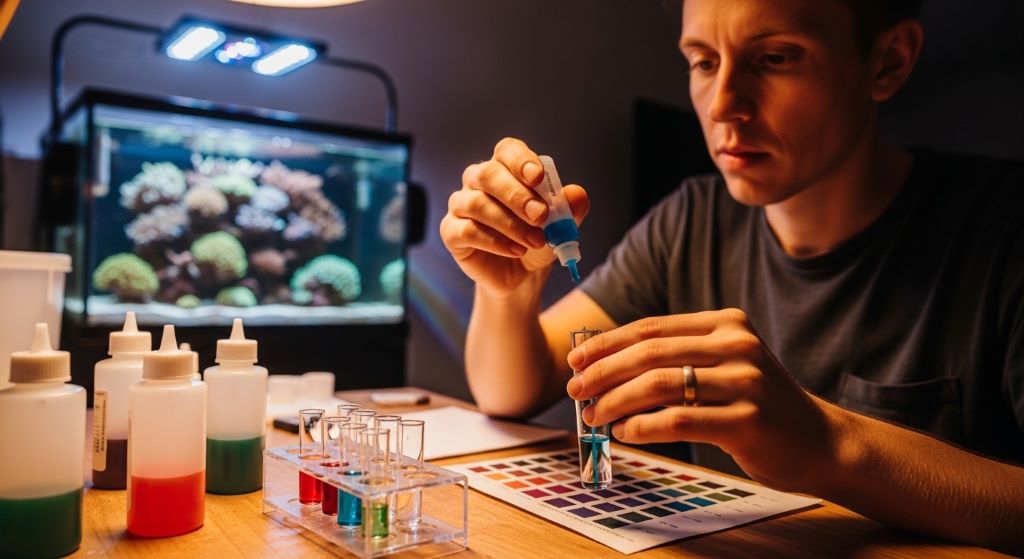
Always rinse your test vials with tank water before adding a fresh sample. Residue from previous tests can skew your readings. Additionally, use fresh, properly stored reagents. Old or heat-damaged reagents give unreliable results even when used correctly.
Take your water samples from the same area of the tank each time. Pulling water from near the surface, near the sump, or near a powerhead can give different readings. Consistency in your sampling location keeps your data comparable week to week.
Read your results in good lighting. Color-based tests are easy to misread in dim or colored light. Use natural daylight or a neutral white light when interpreting colors.
Record every result. A simple notebook or a free app works perfectly. Logging your numbers gives you a trend line over time, not just a snapshot. Therefore, when something starts shifting, you will spot it early.
What to Do When Parameters Are Off
Finding a parameter outside its target range can feel alarming. However, the key is to make corrections slowly. Rapid changes are often more harmful than the imbalance itself.
If alkalinity is low, dose conservatively and retest after 24 hours. Raising alkalinity too quickly can cause precipitation, which crashes both calcium and alkalinity at once. The same principle applies to calcium and magnesium.
For elevated nitrates or phosphates, start by reviewing your feeding habits and skimmer performance. Increasing water change volume or adding refugium macroalgae can bring these down gradually.
If pH is persistently low, improving gas exchange helps. Opening a window near your sump or adding a refugium with a reverse-light-schedule photoperiod are both effective approaches.
Never chase a single bad reading with a large correction. Retest first to confirm the result, then act with patience.
Connecting Testing to Your Broader Maintenance Routine
Water testing does not exist in isolation. It is one part of a complete aquarium maintenance routine that also includes water changes, equipment cleaning, and livestock observation.
Regular water changes dilute accumulated toxins and replenish trace elements that testing kits do not even measure. Most reef keepers do a ten to fifteen percent change every one to two weeks.
Clean your skimmer cup weekly. A skimmer pulling dry or not producing skimmate at all is a sign worth investigating. Additionally, check your return pump and powerheads for flow rate changes, as reduced flow can affect oxygen levels and parameter stability.
Observing your livestock is itself a form of testing. Pale corals, closed polyps, or fish scratching on rocks are all signs worth cross-referencing with your water data. Healthy animals almost always live in healthy water, and tracking both together strengthens your overall home tank health management.
Conclusion
Successful reef keeping starts and ends with water quality. Regular, accurate testing gives you the information you need to catch problems early and keep your tank stable. Building a structured weekly schedule, using reliable equipment, and logging your results consistently turns water testing into one of your most powerful tools.
A disciplined aquarium maintenance routine, paired with careful observation, gives every coral and fish in your tank the best possible chance to thrive. The effort you put into understanding your water today protects everything you have built in your reef tomorrow.
Frequently Asked Questions
How often should I test my reef tank water?
Core parameters like alkalinity should be tested every two to three days. Salinity can be checked daily. Nitrate, phosphate, and pH are typically tested once a week. Adjust the frequency based on your tank’s activity level.
Are test strips accurate enough for a reef tank?
Test strips are generally not accurate enough for reef tanks. They are better suited to freshwater setups. Liquid reagent kits or digital colorimeters provide the precision that reef chemistry requires.
What is the most important parameter to test in a reef tank?
Alkalinity is often considered the most critical. It fluctuates quickly as corals consume it, and large swings cause significant stress. Testing it frequently helps you keep everything else in balance.
Can I use tap water to mix saltwater for my reef tank?
No. Tap water contains chlorine, chloramines, and other contaminants harmful to reef life. Always use reverse osmosis and deionized water, commonly called RO/DI water, for mixing and top-offs.
Why do my calcium and alkalinity keep dropping even when I dose them?
Rapid consumption usually means your corals are growing actively, which is a good sign. However, it can also indicate a dosing imbalance. Check your magnesium levels first, as low magnesium prevents calcium and alkalinity from staying stable even with regular dosing.
Related Topics:
How to Reduce Noise from a Silent Fish Tank Aerator
How to Improve Sleep Quality with the Best Bedroom Humidifier