

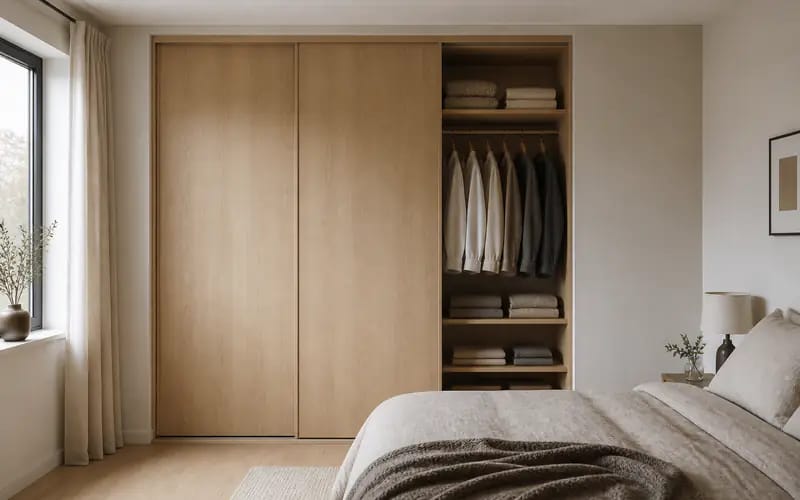
While both types of doors will serve the purpose of a wardrobe, there are marked differences in how they function and how they will impact on the day-to-day use of a bedroom. Here we look at the key factors which affect choice.
Floor Space And Swing Room
The space needed to swing a hinged door open is typically around 50-70cm of floor space, which can mean a bed, a chest of clothes, or even a radiator could be in the way of a hinged door. In contrast, sliding wardrobe doors do not require any clearance space to open and close as they slide along a track in the ceiling or along the floor and so can be placed up against a wall with other furniture in the room. Sliding doors are particularly suited to smaller bedrooms where floor space is at a premium.
Access To The Whole Interior
When opened, hinged wardrobe doors swing outwards so you can access the entire interior of the wardrobe. This is very useful for seeing what’s stored at the back of the high shelves and makes it easier to retrieve items that are stored up high. When you open a sliding wardrobe, you will only be able to see the area behind the open panel(s). A 3-door sliding wardrobe for example will reveal about 1/3 of the total wardrobe space.
Mirrors And Where They Work Best
For a full-length mirror to be most useful, it’s best placed on a hinged door which will reflect the room at an angle when open. This means that when you’re getting dressed in the morning you can check yourself out while moving around the room. However, when the door is opened, the mirror will disappear from view. With a sliding door with a mirror, however, the mirror remains flat against the wall of the wardrobe when it is open, meaning you can still use it to check yourself out.
Tracks, Rollers And Hinges
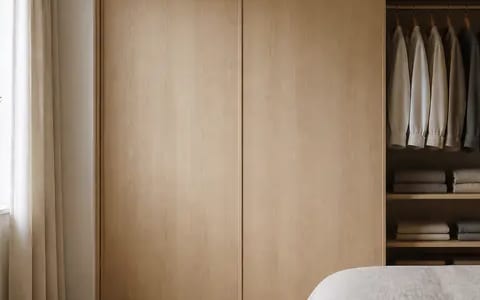
Sliding doors have a top track and often a bottom guide, which are typically made of nylon or steel. These can wear, produce squeaks and even fall off the track if it is covered in dust and fluff. Simply wiping down the tracks every few months and occasionally checking that the top track is firmly fixed to the back of the cupboard will ensure that your sliding doors continue to function properly for years to come. Hinged doors have simple hinges (two or three per door) which occasionally need to have their screws tightened up if a door starts to droop or get stuck. However, generally, hinged doors require very little in terms of maintenance. See also Replacement Wardrobe Doors.
Which Rooms Suit Which Style
For very sloping ceilings or loft conversions, sliding wardrobe doors are usually easier to fit than hinged doors as the sloping ceiling does not allow hinged doors to open fully. Rooms with low ceilings are generally easy to fit either style, but rooms with radiators, desks or beds in front of the wardrobe will generally work better with sliding doors as there is no door to swing open in the space. Square rooms with lots of floor space in front of the wardrobe are also easy to fit with either style.
Cost And Fitting Differences
On the whole, the hinged wardrobe doors are the simplest types to fit. The hinges need to be attached to the back of the door and the wardrobe, and then leveled up. The sliding wardrobe doors require a track to be fitted to the top of the wardrobe, and sometimes to the floor, and these need to be shimma’d up to suit an uneven floor. This additional work is usually reflected in the higher price to fit of the sliding wardrobe doors, although this differential has reduced in recent years with the greater availability of off the shelf track kits.
Matching Doors To Your Existing Wardrobe
If your existing wardrobe carcass is still in good condition, then matching new wardrobe doors to your existing wardrobes can provide a cost effective solution to update your bedroom in a hurry. It is also a good alternative to a full bedroom wardrobe refit. Providing you can get an accurate measure of the opening width and depth, new wardrobe doors can be fitted directly onto your existing wardrobe carcass.
Both styles can work well in many rooms. Ultimately the decision is to weigh up floor space against the ability to see more of your wardrobe. Only by measuring your room for yourself can you make an informed choice between the two.

